
Adult Ballet - Levels 1-4
Finding the Right Adult Ballet Level
Our adult ballet classes are designed for a range of experience levels, from those building a foundation to experienced dancers looking to continue refining their technique. Ballet levels are not simply a checklist of steps to master. Students at every level continue to develop the fundamentals of alignment, strength, coordination, musicality, and artistry. When determining the best level for you, we consider not only your previous experience, but also how consistently you have trained and how recently you danced. If you are returning to ballet after a long break or are unsure which level is right for you, we're happy to help you find a class that will be both appropriately challenging and enjoyable.
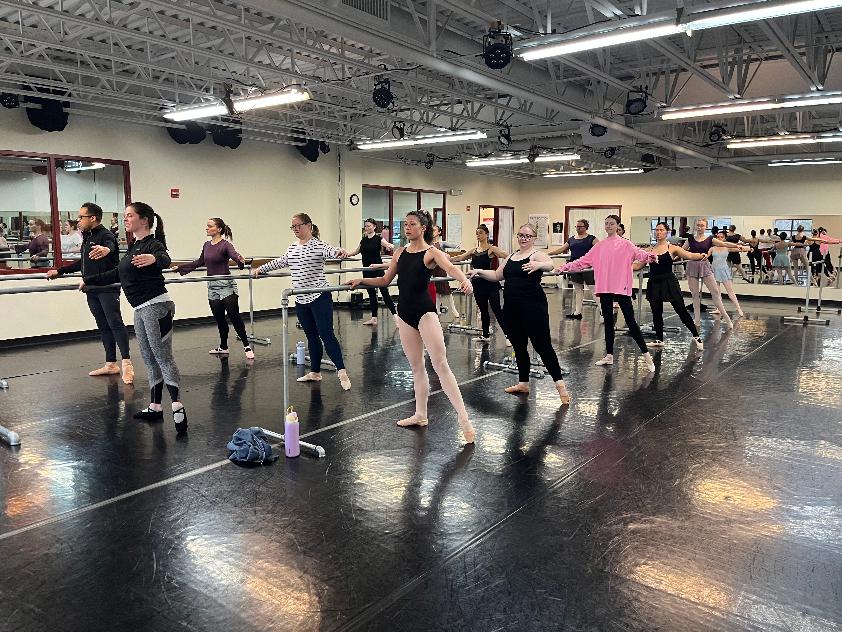
Ballet 1 — Slow Beginner
This class is for you if you:
- Have completed a beginner ballet session, such as our 10-week Absolute Beginner session
- Have approximately 6–12 months of consistent ballet experience, or equivalent previous training
- Know the basic ballet positions and terminology
- Are becoming comfortable with basic barre exercises
- Can follow simple combinations with some repetition
- Are beginning to feel comfortable working in the center
- Are returning to ballet after a long break and want a slower-paced class while rebuilding your technique
You don't need to:
- Be flexible or naturally coordinated
- Have a particular body type or physical background
- Remember everything you've learned in the past
- Have danced recently
- Be comfortable with every ballet term or exercise
What we'll continue working on:
Alignment, turnout, basic positions, port de bras, coordination, balance, musicality, strength, and developing confidence in center work.
You may be ready for Ballet 2 when:
You can comfortably follow a typical Ballet 1 class without needing every exercise broken down and are ready to spend more time refining technique and learning more complex combinations.
Ballet 2 — Advanced Beginner
This class is for you if you:
- Have approximately 1–2+ years of consistent ballet study, or equivalent experience
- Have a solid understanding of basic ballet vocabulary
- Are comfortable working independently at the barre
- Can maintain basic alignment and turnout while performing familiar exercises
- Are comfortable with basic center exercises
- Have some experience with turns and traveling steps
- Can learn a short combination after several demonstrations
- Are ready for a somewhat faster pace and more complex combinations
What we'll continue working on:
Alignment, turnout, strength, coordination, musicality, port de bras, balance, turns, traveling steps, jumps, and the quality of basic technique.
You may be ready for Ballet 3 when:
You can comfortably keep up with the pace of Ballet 2, retain longer combinations, apply corrections, and execute foundational steps with increasing consistency and control.
Ballet 3 — Intermediate
This class is for you if you:
- Have approximately 2–4+ years of consistent ballet training, or equivalent experience
- Have a strong understanding of ballet terminology and basic technique
- Are comfortable working independently at the barre and in center
- Can learn combinations relatively quickly
- Have experience with pirouettes, petite allegro, waltz steps, and other traveling combinations
- Can maintain reasonable alignment and control as exercises become more complex
- Are comfortable receiving corrections and applying them while dancing
- Are ready to work on both how you execute a step and why it is being done a particular way
What we'll continue working on:
Refining foundational technique, strength, balance, coordination, musicality, turns, allegro, épaulement, port de bras, and the ability to execute increasingly complex combinations with control and artistry.
You may be ready for Ballet 4 when:
You can consistently manage the pace and complexity of Ballet 3, learn combinations quickly, maintain your technique as combinations become more demanding, and are ready for greater technical and artistic challenge.
Ballet 4 — Intermediate/Advanced
This class is for you if you:
- Have approximately 4+ years of sustained ballet training, or equivalent experience
- Have a strong foundation in classical ballet technique
- Are very comfortable with ballet vocabulary and can pick up combinations quickly
- Can work independently at the barre and in center
- Have experience with turns, petite and grand allegro, and more complex traveling combinations
- Can maintain alignment, control, and musicality as exercises become more challenging
- Are able to apply corrections independently and make adjustments while dancing
- Enjoy being challenged both technically and artistically
What we'll continue working on:
Refinement of classical technique, strength, control, épaulement, musicality, artistry, turns, allegro, complex coordination, and developing greater efficiency and clarity in movement.
This class may not be the best fit if:
You are still working to become comfortable with basic ballet vocabulary, need significant explanation of fundamental exercises, or find that the pace of a Ballet 3 class is already challenging. In that case, Ballet 3 may provide a more productive environment for continuing to build your technique.
What Do We Mean by “Consistent” Ballet Training?
When we describe a level as appropriate for students with “consistent” or “sustained” ballet training, we are referring not only to the number of years someone has studied ballet, but also to how frequently and consistently they attend class.
Ballet is a cumulative discipline. Each class builds on the coordination, strength, terminology, and movement patterns learned in previous classes. Regular practice allows these skills to become familiar and automatic, which makes it possible to focus on refining technique and learning more complex combinations.
There is no minimum attendance requirement at Ballet U. We are happy to have students who take class occasionally, once a week, or several times a week. Every class is beneficial, and there is value in dancing at whatever frequency works for your life.
However, students who attend at different frequencies should expect different rates of progress.
Occasional attendance
Taking class occasionally is a wonderful way to stay connected to ballet, maintain some flexibility and strength, and enjoy movement. You will continue to benefit from class, but progress will generally be slower. Because there may be significant time between classes, you may need more repetition to remember exercises and combinations.
One class per week
Weekly attendance provides a more consistent foundation. You can expect to gradually build familiarity with ballet vocabulary, exercises, coordination, strength, and musicality. Progress will still take time, particularly as the material becomes more complex, but many adult students make excellent progress with one class per week.
Several classes per week
Attending two or more classes each week provides considerably more opportunity to develop technique. Skills are reinforced more frequently, combinations become easier to retain, and students generally progress more quickly in strength, coordination, musicality, and technical understanding.
Experience Isn't Just Measured in Years
Two students may both say they have “three years of ballet experience” but have had very different amounts of actual training.
For example:
-
A student who attended occasionally for three years has gained valuable experience, but may have had relatively little cumulative training.
-
A student who attended one class each week for three years has developed a more consistent foundation.
-
A student who attended three or four classes each week for three years has had substantially more opportunity to develop strength, coordination, vocabulary, and technical understanding.
For this reason, years of experience are only one factor we consider when recommending a level.
More Advanced Doesn't Always Mean More Appropriate
It is completely understandable to want to challenge yourself and move forward. However, moving into a higher-level class before your foundational technique is ready can sometimes make it harder, rather than easier, to progress.
Higher-level classes don't simply introduce more difficult steps. They generally move at a faster pace, assume greater familiarity with ballet vocabulary, and require students to manage more complicated combinations while continuing to maintain their technique.
A student may be capable of performing an individual step from a higher-level class but still benefit from spending more time in a lower level developing the underlying skills that make that step stronger, more consistent, and more useful.
There is no disadvantage to working at the level that is right for you. In fact, some of the most productive ballet training happens when you have enough familiarity with the material to focus on the details: alignment, placement, coordination, musicality, épaulement, strength, and quality of movement.
Our goal is not simply to move you through the levels. Our goal is to help you become a better dancer.
How Often Should I Attend Classes?
As often as you can—and as often as you want!
We know that adult life is busy. Work, family, travel, and all the other things that fill our calendars can make a regular schedule difficult. That's why there is no single “right” amount of ballet to take.
Some of our students join us once a month. Others come once a week, several times a week, or even four times a week. We are happy to have you in class whenever you can make it.
If you're looking to steadily develop your technique, attending regularly will help you build strength, coordination, familiarity, and confidence more quickly. But even an occasional class is worthwhile—and it's certainly better than not dancing at all!
Most importantly, we're glad you're here. We want adult ballet to be something you look forward to, not another obligation on your to-do list. Whether you have an hour a month or several hours a week to devote to yourself, we're happy to share the barre with you.
Take the class you can fit into your life. We'll be here when you're ready to dance.
© Copyright Ballet U, LLC